
- Glossary of terms
- Core stability (rompstabiliteit)
Core stability (rompstabiliteit)
Core stability refers to the stability of the body's core. The term "core" literally means "center," and it includes the spine, abdomen, hips, pelvis, and thighs. Core stability is crucial as it provides a foundation for moving the arms and legs, absorbing forces, and protecting the spine.
Core stability training originated in physiotherapy and rehabilitation and is increasingly incorporated into sports training.
Small and large muscles
The muscles in the body can be broadly divided into two categories: large muscles, which primarily generate force, and smaller muscles, which provide stability. Large muscles include the thigh muscles, hamstrings, and abdominal muscles. The smaller muscles lie beneath these larger muscles and include, for example, the muscles that connect vertebra to vertebra. Core stability training focuses particularly on strengthening these smaller muscles.
Training core stability in athletes
Core stability training in athletes aims to strengthen the entire body and prevent injuries. A stronger core improves technique, endurance, and overall strength.
For example, in football, a stronger trunk can enhance the power of a shot. Tennis players may notice an improvement in their strokes. Every sport can benefit from core stability training, and a stronger trunk reduces the risk of injuries.
When athletes experience back, groin, or hamstring issues, it is often due to poorly functioning stabilizing muscles. Therefore, core stability exercises are essential for recovery. It is advisable to include core stability exercises as a regular part of the warm-up. If a trainer notices that an athlete is not stabilizing their trunk properly, that athlete should focus more on trunk stability training.
Training the core
Training the trunk muscles involves more than just strength training; correct activation and endurance of the various muscles are also important. The foundation of good trunk stability begins with learning to properly contract the stabilizing muscles of the abdomen, back, and hips. Once this is mastered, the exercises can be expanded.
The exercises start gently, with minimal noticeable fatigue. The initial exercises are performed in the supine position, where the core does not have to support body weight, allowing for targeted training of the stabilizing muscles.
Once the body has learned to contract these muscles correctly, the exercises can be made more challenging.
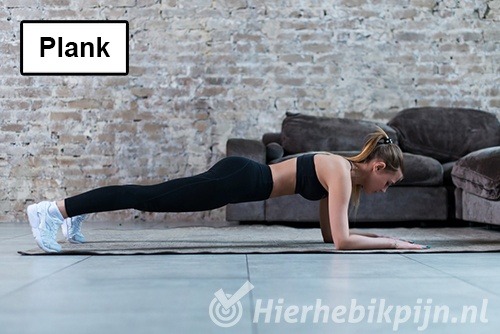
A common example of poor core control is experiencing back pain during the 'plank' exercise. This indicates that the smaller stabilizing muscles are not adequately protecting the spine from 'sagging,' even though the larger muscles may still have sufficient strength to maintain the posture.
After learning to correctly contract all the stabilizing muscles, it is important to maintain this control during movement. Exercises are expanded by incorporating movements of the arms and legs.
Correct execution of the exercises is essential. Strength training with free weights, such as squats and lunges, are also core stability exercises. These can be made more challenging by adding extra weights, speed, or jump variations. It is important to only increase the difficulty of exercises once the preceding exercises are performed flawlessly.
Core stability exercises
Plank exercise:
Side plank exercise:
Side plank variation:
Advice
If you have back pain and want to start core stability exercises, consult a fitness trainer or physiotherapist for advice. There is always a nearby physiotherapist who can assist you further.
Related topics
- Akinesia
- Anterior and posterior
- Bradykinesia
- Conservative or operative
- Core stability (rompstabiliteit)
- Cranial and caudal
- Curative or palliative
- Hypokinesia
- Kinematic chain
- Lateral and medial
- Morbidity, multimorbidity and comorbidity
- Movements
- Muscle coordination
- Progressive and regressive
- Proximal and distal
- Vein
- Ventral and dorsal